Key takeaways
- “Vibe coding” was coined by Andrej Karpathy in February 2025 for a way of programming where you give in to the AI and “forget that the code even exists”.
- It is a fun and fast way to make prototypes. It is a poor way to build something a business depends on for years, because nobody understands what was built.
- I build sites on a structured system instead: a standard platform, themes designed for each kind of site, and the same checked steps every time.
- AI has a place inside that system, for drafts and checks, but not as the architect.
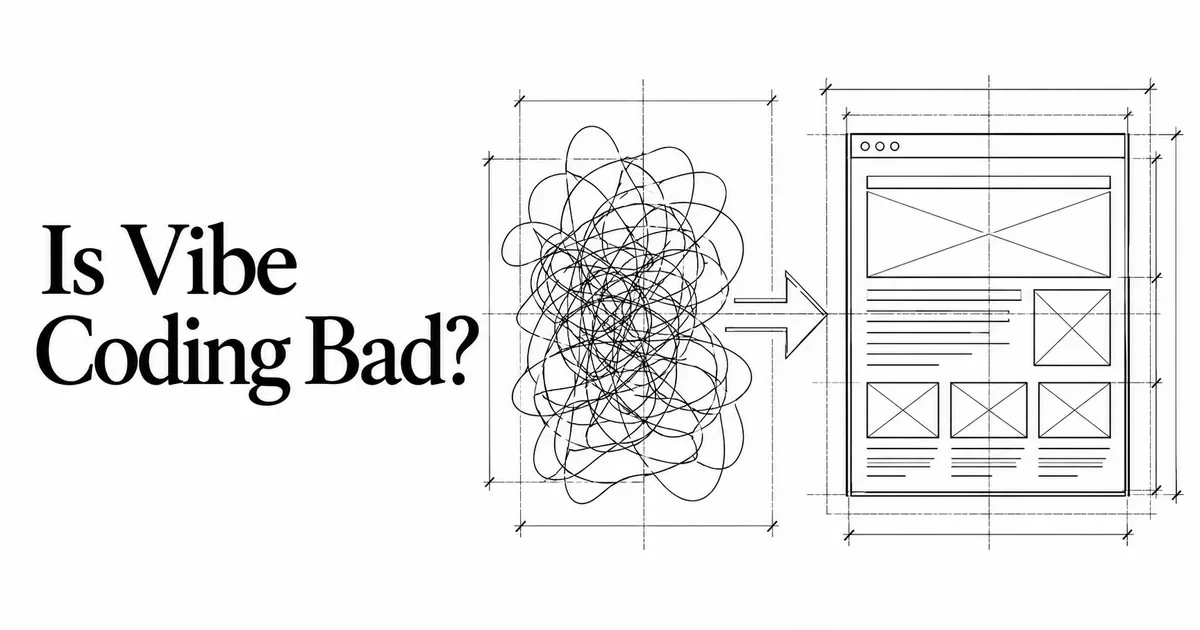
In February 2025 Andrej Karpathy, a well-known AI researcher, gave a name to something many people were already doing. He called it vibe coding: a way of programming where you describe what you want, accept whatever the AI produces, and, in his words, “forget that the code even exists”. The name stuck because it described a real shift.
I want to be careful here, because I use AI every day and I am not writing a complaint about it. I am writing about the difference between improvising a website and building one on a structure, and why, for sites that people depend on, I always choose the second.
What vibe coding is good at
Vibe coding is genuinely good for some things. A quick prototype to test an idea. A personal tool you will use for a month. A demo for a meeting. In all of those, speed matters more than durability, and if the result breaks you throw it away and make another.
The problem starts when something made that way becomes something people rely on: a business website, an online shop, the pages around a product. Those are not throwaway. They will be changed hundreds of times, by different people, over years.
The problem with improvised sites
An improvised site, whether improvised by a person in a hurry or by an AI following prompts, tends to have the same weaknesses.
No one knows why it is the way it is. Decisions were not made. They happened. When something needs to change, there is no reasoning to follow.
Every part is a one-off. The contact page is built differently from the about page, which is built differently from the blog. There is no system, so there is nothing to reuse.
Changes compound the mess. Each new request adds another layer of improvisation on top of the last. I describe what that looks like for owners in You Built Your Site With an AI Website Builder. Now Who Can Change It?
Nobody else can take it over. Without a standard and without a system, a new developer has to start by reverse-engineering what is there.
What structured work looks like
The alternative is not slower or more expensive in the long run. It is just decided in advance. When I build a site, the decisions that matter have already been made, once, carefully, and written into the tools:
- A standard platform. WordPress, so the site is something thousands of people already understand. I explain why in Why Use WordPress? Because Any Developer Can Pick It Up.
- A theme designed for the kind of site. The structure of pages, article types and archives is part of the foundation, not invented on the day.
- A known architecture. Main topics with their own pillar pages, articles grouped under them, and links that follow the structure.
- The same checked steps every time. Set up, content, structured data, checks, launch. If a step improves, it improves for every site.
None of this stops a site from being original. It means the originality goes into the content, the design and the details that make the site belong to its owner, not into reinventing the plumbing.
Where AI fits
Inside a structured system, AI is useful in very specific places. It can help draft a first version of a page that a person then edits. It can suggest alternative wording for a heading. It can check whether image descriptions are clear, or flag a paragraph that is hard to read. Each of those is a contained task with a person deciding what stays.
What I do not let it do is design the system. The architecture of a site, how its parts relate and what it is built on, is exactly the kind of decision that needs to be made deliberately and understood by the people who will maintain it.
Why this is part of being well built
My second rule says a site should be well built. For me that has never meant clever. It means understandable, repeatable and maintainable: a site whose structure someone chose for reasons, and that someone else can pick up and continue. Vibe coding, by its own definition, gives up on understanding the code. That is precisely the thing a site someone depends on cannot give up.
Frequently asked questions
What is vibe coding?
A term coined by Andrej Karpathy in February 2025 for programming by prompting an AI and accepting its output, while giving in to the vibes and forgetting that the code even exists.
Is vibe coding bad?
Not for prototypes and personal experiments. It becomes risky for sites a business depends on, because nobody understands the code well enough to maintain it.
Can AI be used to build a website responsibly?
Yes, inside a structured process: a standard platform and a planned architecture, with AI helping on contained tasks such as drafts and checks, and people making the decisions.